

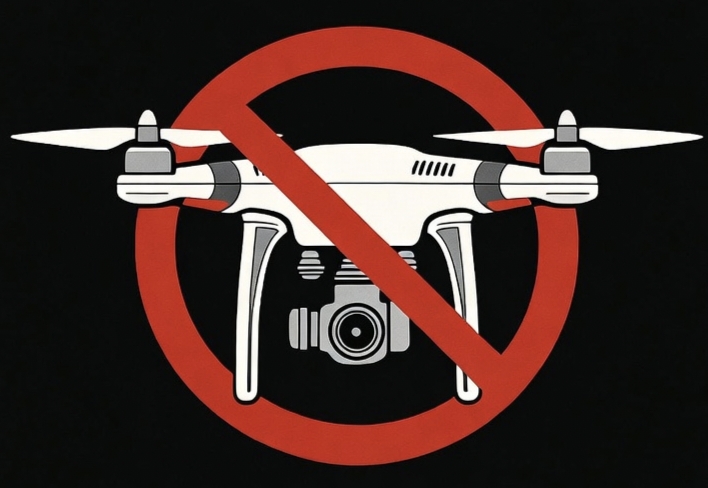
Drone security risks
In an age where technology has outpaced wisdom, the most serious threats to national security no longer always arrive wearing uniforms or carrying weapons. Sometimes, they arrive as short videos, aesthetic aerial shots, or viral reels uploaded casually, consumed endlessly, and forgotten quickly, while the damage they cause remains invisible and enduring.
Nowhere is this contradiction more stark than in India’s sensitive border districts such as Poonch. Nestled along a volatile frontier, this region has historically carried the burden of vigilance, sacrifice, and strategic importance. Yet today, it is increasingly being turned into an open visual archive by unregulated drone cameras operated in the name of social media content creation.
What is presented as art, tourism promotion, journalism, or digital storytelling often masks a far more troubling reality: the uncontrolled aerial documentation of a strategically sensitive region.
Drone technology is not inherently dangerous. Like all tools, its impact depends on how it is used. However, in border areas, visibility itself can become vulnerability. Aerial footage reveals far more than scenic landscapes. It captures terrain contours, road connectivity, settlement patterns, elevation gradients, and infrastructural layouts information that, when aggregated, can offer a comprehensive spatial understanding of the region.
In modern conflict dynamics, such information is invaluable.
What once required intelligence networks, reconnaissance missions, and high-risk operations can now be passively gathered through publicly shared videos. The uncomfortable truth is that open social media platforms have become repositories of strategic data, often curated unwittingly by citizens themselves.
This is not speculation. It is the established reality of contemporary hybrid warfare.
A particularly concerning aspect of this trend is its association with what is increasingly termed citizen journalism, a phrase that has lost much of its original meaning. Journalism, in its classical sense, was bound by editorial oversight, ethical codes, accountability, and an understanding of public interest versus public harm.
Today, in many cases, the title of journalist is self-assigned, the newsroom replaced by a smartphone, and editorial judgment substituted by algorithms.
In districts like Poonch, this has resulted in drone usage by individuals with:
No institutional affiliation,No professional training,No editorial supervision,No understanding of security sensitivities .
The pursuit is not public awareness but visibility, monetization, and digital relevance. In this environment, virality has replaced verification, and spectacle has eclipsed responsibility.
Defenders of such content often argue that their intent is benign promoting tourism, celebrating natural beauty, or documenting adventure. Intent, however, is not the sole determinant of consequence.
A border region is not merely a canvas for creativity. It is a layered space where civilian life, security infrastructure, and strategic geography coexist delicately. What appears to one person as an artistic aerial sweep may to another serve as a detailed spatial reference.
History repeatedly teaches that harm does not always arise from malice; it often arises from ignorance coupled with access.
Contemporary security challenges are no longer confined to borders and bunkers. They extend into data ecosystems, digital platforms, and open-source intelligence spaces. Militaries and hostile actors worldwide actively study publicly available imagery to understand terrain, access routes, and settlement behavior.
In this context, the casual uploading of drone footage from sensitive areas becomes part of a larger, unintended intelligence chain. No passwords are hacked. No systems are breached. The information is simply handed over free, high-resolution, and contextualized.
The paradox is unsettling: the same citizens who live under the protection of security forces may inadvertently undermine that very shield.
This issue cannot be addressed through enforcement alone. While regulatory clarity and administrative vigilance are necessary, they are insufficient without public awareness and ethical restraint.
Border communities have historically demonstrated resilience and loyalty under extraordinary circumstances. That legacy must now extend into the digital domain. The question is no longer whether one has the right to record, but whether one has the responsibility to refrain.
Freedom without discernment weakens societies from within.
This editorial is not an argument against technology, creativity, or expression. It is an appeal for maturity individual, social, and institutional.
Sensitive regions require sensitive behavior. Not everything visible must be shown. Not everything recordable must be recorded. And not everything shareable must be shared.
In border districts, silence can be strategic. Absence can be protective. And restraint can be the highest form of patriotism.
National security is not compromised only by overt acts of hostility. It is often eroded quietly, incrementally, and unintentionally through habits that normalize exposure and glorify visibility without reflection.
As the line between private content and public consequence continues to blur, society must ask itself a difficult question:
Are we documenting our homeland for pride or displaying it at a cost we do not fully understand?
In regions like Poonch, the answer to that question may determine far more than online engagement metrics. It may determine the difference between safety preserved and security diluted.
And by the time that distinction becomes visible, it may already be too late.
Drone security risks





Leave a Reply